
Niagara’s billion-dollar wine and grape industry relies heavily on the skill and sacrifices of migrant workers, who are mainly from the Caribbean and Mexico. Their economic and social impact is far reaching, yet they remain invisible and excluded from today’s celebration.
Since 1966, thousands of migrant workers have been employed in Ontario’s fields and greenhouses. Migrant workers are tied to an employer, are denied labour and social mobility and must return home when their contracts end. Even though they pay into Canada’s social safety net, migrant workers are denied many of the basic entitlements Canadians enjoy. If we peel back the veil, we can see the wealth of local wineries and vineyards occurs on the backs of unfree workers.
When migrant workers are injured or sick they are often sent home, thus downloading healthcare costs to the families of the sick and injured. Many of these workers are no longer able to work after sustaining injuries and sicknesses while working in Canada. Between 2001-11, 787 migrant farm workers were returned to their countries of origin due to illness or injury — 98% of these repatriations were not based on workers’ requests.
Dozens of migrants have died as a result of working conditions on farms. These include the deaths of migrant farm workers such as Ned Livingston Peart, Sheldon McKenzie, Omar Graham and Ezequiel Cervantes-Nava, all of whom died from preventable workplace accidents. To date, there has never been a coroner’s inquest into the death of a migrant farm worker anywhere in Canada.
Farm workers are not entitled to overtime pay, holiday pay or many other protections under Ontario’s Employment Standard Act. Few protections exist for farm workers from pesticides, chemicals or dangerous working conditions.
TAKE ACTION:
Phone and/or email your Member of Parliament (click here to find them by your postal code), and CC J4mw.on@gmail.com. You can also tweet @AhmedDHussen and @PattyHajdu.
Ask them to support:
- Landed status on arrival for all migrant workers;
- Equal access to all social programs (including Employment Insurance)
- Ending the unilateral repatriations of migrant workers, and implementing an appeals process so migrant workers aren’t simply deported because an employer says so.
Phone and or email your MPP. Ask them to ensure:
- Both occupational health & safety and employment standards are modernized to protect the rights of low-wage migrant workers.
- Random spot-checks at farm sites and employer-provided accommodations.
- Access to provincial health insurance on arrival, stopping the practice of medical repatriations whereby sick and injured migrants are sent home, and ending discriminatory workers compensation practises that deny migrant workers equal access to benefits.


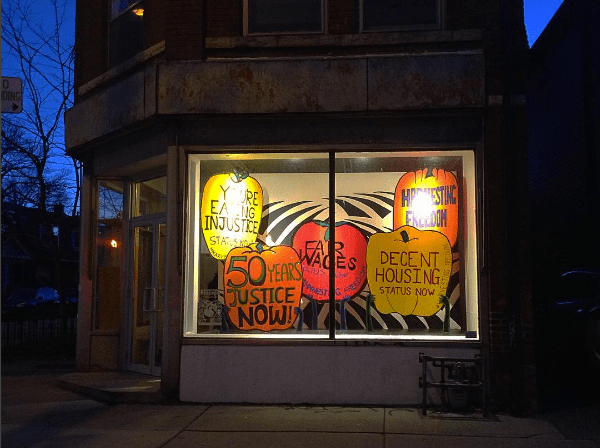
 Spring has arrived, and many of our brothers and sisters on the Seasonal Agricultural Worker Program are returning to southern Ontario. We thought we would take this opportunity to provide an update on a story that happened at the tail end of last year’s season.
 In October 2016, just before the workers returned home at the end of the season, two Justicia volunteers traveled to Brantford and provided each of the 32 workers with cheques for $687. The gratitude was overwhelming, and important bonds were built which will hopefully last through many seasons to come.
 In preparation for tomorrow’s event Against Islamophobia and White Supremacy, we prepared a handy listicle on 12 ways Canadian immigration policy reinforces Islamophobia, white supremacy and racism. Check out